Archive for October, 2026
From glaciers melting to sea rise repercussions, fossil fuels are to blame
“The State of the Global Climate is in a state of emergency. Planet Earth is being pushed beyond its limits. Every key climate indicator is flashing red… Humanity has just endured the eleven hottest years on record. When history repeats itself eleven times, it is no longer a coincidence. It is a call to act.” —UN secretary-general António Guterres
“Cleverness may help at the margins—as when chemists identify a relatively harmless substance that can substitute for a toxic one. But without self-limits on population and consumption, no amount of cleverness can halt humanity’s accelerating march toward collapse… There is the uber-problem that should be at the top of all our minds—the long-term survival of humanity. We naturally want our species to stick around. And we like to think that our intelligence improves our prospects in that regard. But, so far, the evidence points in the opposite direction.”
—Richard Heinberg
“If we do nothing, we still get to a post-carbon future, but it will be bleak. However, if we plan the transition, we can have a world that supports robust communities of healthy, creative people and ecosystems with millions of other species.” —Richard Heinberg, educator and writer on energy, economic and ecological issues
Decades ago, when I visited the Columbia Icefield in the Canadian Rocky Mountains, the well-documented melting of the Athabasca Glacier, one of several that are spawned from the massive icefield, was a stark reminder of the human-induced impact on our planet’s recent history. Five metres of ice a year are being lost now, and as I saw the historical signposts marking the previous glacial limits of the ice, it came as quite a shock to physically witness the accelerating decline of the glacier. The Columbia Icefield is not alone in the rapid disintegration of the world’s glaciers. The Swiss glaciers are now considered to be doomed in this century. The 2026 heatwaves alone brought about a loss of five metres in ice thickness. In Nepal, new glacial breakdown is taking place on a devastating scale. The recent catastrophe in which a glacier and its rocks and mud broke off, causing the deaths of thousands of people, is but one more graphic example of the intensification of a warming planet. If all this is not a call to action for all people, what will finally cause humankind to wake up?
As glaciers melt, so does ultimately the capacity for over a billion people to have what was until now a reliable source of water for their survival, and this extends to all biological life forms. Flooding followed by drought is the natural sequence of events as the glaciers are depleted. Without the great icefields of the Himalayas there would never have been the flourishing of civilizations, as the mighty rivers that emanate from glaciers could not have existed.
For the same reasons that glaciers melt—predominantly human-induced climate warming—the ocean heats up. Every tenth of a percent of global warming causes a massive die-off of fish who can’t adapt to a warmer marine life and there is a limit to how far north they could migrate to find cooler waters.
The ocean that warms is also the ocean that is rising. In a rare case of solidarity, all 193 member states of the UN ratified the 2026 Declaration on Sea Level Rise. The low-lying island states who brought the declaration forward pointed to the fact that their territories will disappear under water and as a result their citizens will be stateless:
“Sea level rise may threaten our coasts, our homes and our ways of life. It does not threaten our legal rights, entitlements or existence as states,” said Surangel Whipps Jr., president of Palau, speaking on behalf of the 39 members of the Alliance of Small Island States.
The Declaration itself says: “Sea level rise is not a distant scenario but a real and lived experience for many. Rising sea levels are primarily driven by ocean warming and melting ice sheets and glaciers, and we note with concern this phenomenon is accelerating. It imperils people living on islands and in coastal regions, low-lying deltas and archipelagos around the world, and erodes hard-won development gains, especially for developing countries and in particular, Small Island Developing States (SIDS) and Least Developed Countries (LDCs).” https://tinyurl.com/declaration-sea-level
With the knowledge that currently 91% of all global heating is transferred to the ocean, 5% to the land, 1% to the atmosphere, and 3% melts ice in high altitudes, and crucially that humanity is now suffering heatwaves from just 6% of global heating (land and atmosphere), what can we expect in the coming months when El Niño’s full capacity unleashes the ocean’s enormous heat? Combine El Niño with climate breakdown, and we are about to be targeted with a plethora of new disasters. As a greenhouse gas, carbon dioxide (CO2) warms the atmosphere. Since 1958, the burning of fossil fuels has increased CO2 levels dramatically. The latest figure published by the US National Oceanic and Atmospheric Administration (NOAA), in mid-August this year, showed a level of 426.43ppm (the number of CO2 molecules per million molecules of dry air). See these astonishing graphs: https://tinyurl.com/carbon-dioxide-rise
Canada is in the throes of seeking a way out from its understandably major concerns about the breakdown of its alliance with the US, but Mark Carney’s recent announcement that a 1,250-kilometre pipeline from Alberta’s tar sands to the Pacific, costing approximately $35 billion, would alleviate security problems is sheer fantasy. Nevertheless, energy minister Tim Hodgson declared it a “good investment for Canadian taxpayers.” Any new fossil-fuel infrastructure locks the world into a descending ecological and climate spiral of destruction. Fossil fuels must stay in the ground.
An island that is submerged, a coral reef’s fecund biodiversity succumbing to rising ocean temperature, the great forests no longer protected from deforestation and hence drought, and the birds who are no longer finding refuge in previously secure forests and wetlands or even showing up at our bird feeders are all reasons to work with biodiversity groups that rigorously oppose the desecration of our planet. Organizations such as EcoJustice, the David Suzuki Foundation, the Center for Biological Diversity, the Canadian Parks and Wilderness Society and the Sierra Club are a good start.
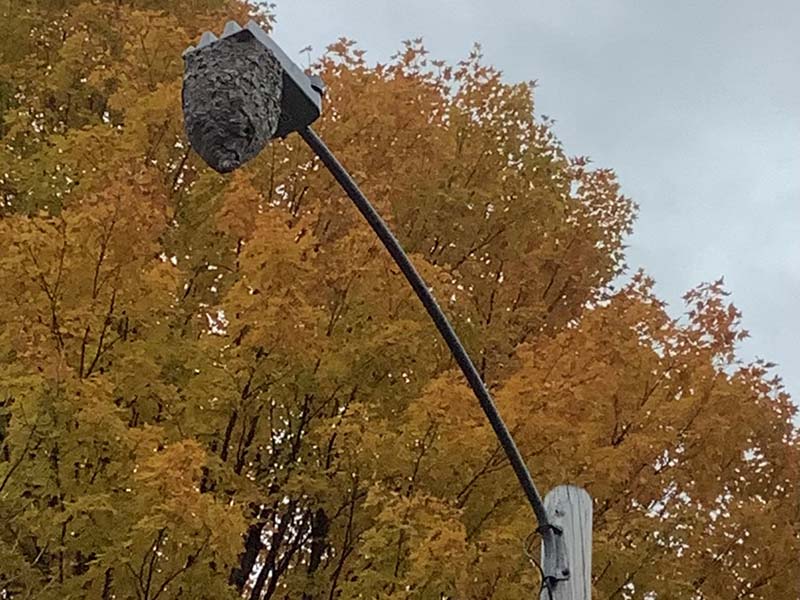
At the same time, an appreciation of the cycles of Nature can ward off the most pessimistic evaluations of planetary demise. As the last vestiges of summer’s flowers give way to colder temperatures, asters and sunflowers in the last two weeks became havens for bumblebees taking refuge on the flowers and finding heat and comfort in the wind and rain. And a paper wasp nest encapsulated a street light, turning off the light and returning a little more of the night sky.