Archive for the ‘Nature Articles’ Category
From sea to blighted sea: a cautionary tale for Georgian Bay’s fishery
“There is no nonsense so arrant that it cannot be made the creed of the vast majority by adequate governmental action.”- Bertrand Russell
“…sea lice from open net-cage salmon farms are pushing wild salmon toward extinction.” Alexandra Morton, biologist
Canadians watched as our Atlantic cod disappeared through the 1970’s. The ecological disaster intensifying in the Arctic as a result of pollutants and habitat destruction from the Tar Sands’ impact on the Athabasca River and the boreal forest is well documented. Canadians are now faced with the obliteration of our coastal and riparian Pacific ecosystems with a catastrophic collapse of salmon. Individuals such as biologist, Alexandria Morton and non-government organizations www.livingoceans.org, www.callingfromthecoast.com, www.raincoastresearch.org have succeeded in court by making a reluctant federal government take over the regulation of open net-cage fish farms, and a long over-due federal inquiry will determine the viability of these farms. The B.C. Supreme Court has now halted the expansion of these farms till next December.
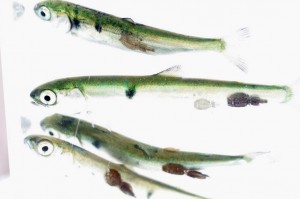
Sea Lice Effects on Wild Pink Juvenile Salmon - Photo: Alexandra Morton
Since the late 1980’s salmon farms have been allowed to proliferate along the B.C’s coast, and most importantly on the very migration routes where wild salmon must swim to go up rivers such as the Fraser and spawn. Disease epidemics, escape of non-native Atlantic salmon, drowning of marine mammals in farm nets, parasites such as the infestation of sea lice on baby salmon, pharmaceutical and other chemical pollutants, as well as the sheer biomass and the excrement of salmon create all the conditions for a crash of not just salmon but for the marine species including sea lions, whales and bears that feed on wild salmon as well as shell fish beneath these farms. Add to this the impact on First Nations’ way of life when only one-tenth of expected wild sockeye salmon return to the rivers to spawn.
Salmon farms in Norway and in Ireland have already devastated local fisheries, so why would Canada’s Minister of Fisheries and Oceans, Gail Shea, go last summer to Norway to showcase B.C.’s aquaculture industry? Plutocracy is alive and well in Canada!
One clue that sheds light on why our nation would allow the wild salmon population to collapse can be found in a famous essay by Garrett Hardin called “The Tragedy of the Commons”. Think of the ‘commons’ as those areas of our planet that are owned communally such as our seas, atmosphere and even our national and provincial parks. Hardin says, “Freedom in a commons brings ruin to all.” Would this explain why international conventions on climate, biodiversity and even the Convention on the Law of the Sea have had little impact in stopping ecological disasters from happening? Does humanity have such a contemptuous disregard for ‘free-to-take’ Nature that, if given the chance, would pull out the underpinning structures that account for our ability to survive? Does this give us an insight into why Canada and other governments are so eager to exploit an ice-free ‘communal’ Arctic Ocean that will make trillions of dollars for oil, gas and mining corporations, but will subject its indigenous peoples and native species to the same ecological tragedies found in the south?
Our next article will look more closely at what is happening in our Bay, but suffice it to say for now that in 2005 The Environmental Commissioner of Ontario, Gord Miller, spoke out against aquaculture farming for similar concerns that now plague the Pacific coast’s wild salmon population.
What you can do right now is to refuse to buy farm-raised salmon. For those who have pets, buy food that does not have salmon (or tuna) in the ingredients. Meanwhile, Target Corp’s 1,744 U.S. stores will ban farmed salmon. Ask your local store to do the same. Going to the Olympics? King Harald of Norway is being presented a letter protesting the fact that 92 percent of B.C.’s fish farms are owned by Norwegian companies, and with good reason, salmon farms are banned in many Norwegian fjords. Be a signatory.
[youtube=http://www.youtube.com/watch?v=Y9kdSSdzo_Q]

Alternative ‘green’ fuels create more ethical questions
“Corn causes more soil erosion than any other crop grown in the United States…Producing ethanol or biodiesel from plant biomass is going down the wrong road because you use more energy to produce these fuels than you get out from the combustion of these products.” David Pimentel, agricultural scientist at Cornell University
“Political leaders stress the importance of technological innovation as a primary means of eventually reducing carbon emissions. This is wishful thinking on an extraordinary scale.” Chris Goodall, “How to lead a low-carbon life”
Rudolf Diesel’s engine ran off peanut oil at the Paris World Fair in 1900. Fuels derived from plants, their seeds and even from algae have caught the imagination of researchers for over 100 years. Sometimes, fuel made from corn, sugar cane or soy is called agrofuels. These fuels have been the forage for intense debates between industry hopefuls who obtain their money from oil companies such as BP, venture capitalists as well as governments who are, in many instances, pitted against conservationists. In 2010 the controversy over ‘renewable’ type fuels is more complicated than ever. It’s not just the low energy return on the energy invested in producing the fuels that have created the conflagration. The controversy has spread to the acknowledgement of biodiversity loss where these plants are grown, to even the car and marine industries who say that a higher blend (going from 10 to 15 per cent) of ethanol will ruin engines.
Now a whole array of African, Chinese, Indonesian and Indian groups oppose increasing the acreage of these crops. In Africa non-government organizations and scientists are warning that mono-crops such as palm oil and what was once called the ‘wonder weed’ because it can grow on marginal lands, jatropha, will have disastrous consequences if corporations gain control of farm land. Food security, displaced farmers, deforestation, and conservation lands are all threatened in the wake of the agro fuel ‘miracle’. In places such as Ethiopia’s Babile Elephant Sanctuary where 300 elephants and 1,000 black manned lions live and are revered by people, a German biodiesel company has leveled huge tracts of conservation land. In fact, the European Union is being pressured to lower its biofuel targets as a result of similar tragic examples including Uganda’s Mabira Forest that is a water catchment area for the Nile and Lake Victoria. In Indonesia the destruction of the orangutans’ last remaining habitat and the gargantuan levels of greenhouse gas emissions coming with forest destruction and burning, has brought huge criticism for the profligate misuse of lands to grow these fuels. Ecological services are not respected by some corporations because many times they are ‘given’ out for free and are then over-exploited. To the contrary, it is estimated that in India up to 57 percent of the ‘wealth’ of the poor can be attributed to these same ‘free’ open access services and are often cared for.
As more questions come up regarding the viability of biofuels including cellulosic ethanol (fuel produced from grasses, agricultural residue and municipal waste), many companies are investing in algae as the perceived panacea to wean us away from fossil fuels. ExxonMobil, Chevron, Bill Gates’ Cascade investments and Dow Chemical are investing more than a billion dollars in taking algae from the laboratory and into the field. Algae’s photosynthetic cells produce oils and ethanol and can be far more efficient than corn on a per hectare basis. There is even what is called “green gasoline” made from the woody remains of plants that is similar to fossil fuels in their composition.
It is no secret that these biofuels will never be able to replace the vast volume of fossil fuels if we have more consumption and a larger population. Furthermore, all the alternative fuel hype has not translated into ethical ways to lower our carbon footprints. The technological silver bullet for our troubles hasn’t materialized. It’s time that we rethink what each of us can do to move past the consumption bottleneck that has created the demand for more fossil fuels to begin with.
Better Transportation Leads the way for Healthy Green Communities
Better Transportation Leads the way for Healthy Green Communities
Since the 1990’s World Car Free Day is held in many parts of the world on September 22. Car Free Sundays have also found a following in Canada including Vancouver neighbourhoods. Closer to home, Toronto’s Kensington Market becomes a refuge from the automobile throughout the summer on Sundays. If you add all those fabulous street musicians, wonderful cozy outdoor ethnic restaurants, vegetable and cheese shops, and top it off with the coolest clothing and art places, Kensington Market is a vibrant and happy place to be on a Sunday. Why can’t our Georgian Triangle communities do the same for our citizens?
In many parts of the globe car free days have become the impetus for further changes in town planning and have rightfully deflated the notion that cars are good for business and society. As well, our small towns can take a resilient path and be models for re-localization efforts by first reexamining our unhealthy car dependent society. As oil becomes more and more expensive and climate safety issues are finally taken seriously, small towns will have to move to mass transportation and simple changes such as making walking and bicycle transportation a priority. More than thirty per cent of Copenhagen’s citizens travel by bicycle regularly around that city for work and recreation, and alternative energy projects are now synonymous with Denmark.
There are historic communities around the world that don’t allow cars on any day and they still thrive. If our towns are committed to making a much needed transition away from 21st century fossil fuel dependency, one of the first places we should be exploring is how car free towns actually help out commerce, significantly lower pollution and massively reduce a staggering amount of greenhouse gases that cars produce.
Albert Koehl is a passionate advocate and educator of alternative transportation possibilities. He is also a lawyer with EcoJustice. (EcoJusitice Canada is a non-profit law and science organization that defends citizens’ rights in court to have clean water, natural spaces and healthy communities. Please see www.ecojustice.ca) Albert has successfully looked at how our society can find ways to lower greenhouse gas emissions. Through the years, his insightful Toronto Star transportation articles have encouraged citizens, politicians and planners to reassess how we build our streets and open spaces to accommodate the real drivers of commerce and healthy communities: the pedestrian and cyclist. He says, “A recent report by the Clean Air Partnership about Bloor St. in the Annex found that only 10 per cent of patrons at local businesses arrive by car and that patrons arriving by foot and bicycle spend the most money each month.” Mr. Koehl has also studied mass transit in Argentina and in Ontario. His description of the amenities that buses have in Argentina (the same that we expect flying first class- yes wine is served) can easily be brought to our communities and make traveling by bus far more popular.
Our municipal governments need to stop talking about sustainability and be part of the solution to green our communities. If ski resorts want to keep their snow in 2030, perhaps those businesses should be working to educate their clients and defend new green transportation legislation in the future. As well, municipal governments must augment green business initiatives and have the courage to work with their provincial counterparts to steadfastly mandate that thousands of skiers come up to our area by modern buses instead of creating more greenhouse gases with SUVs. At the very least, let’s start the process by having an anti-idling, no drive-through car by-law with teeth in Meaford, Grey Highlands and the Town of Blue Mountains that helps make driving an anti-social behaviour, like smoking is now. Let’s get to work. Happy New Year!
“It’s time to let truth, thoughtfulness,
justice, and beauty capture our
hearts and minds; time to stop living in
fear that things will go wrong and to start
making sure that things go right. It’s time
to change the way we live.” Orion Magazine Editorial January 2010
Actions and Vigils for Copenhagen Create Movement to Stem Climate Change
The ultimate test of a moral society is the kind of world that it leaves to its children.” Dietrich Bonhoeffer, pastor and anti-Nazi activist
As the eyes of the world turn to Copenhagen, the youth of the world will make sure that world leaders are held accountable to global citizens and all future generations. Watch out – we’re here.” -Amber Church, Canadian Youth Climate Coalition National Director in Copenhagen
There is something fundamentally wrong with treating the earth as if it were a business in liquidation.” Herman Daly, economist
When I visited a combined grade 12 law and biology class at Georgian Bay Secondary School last week, the Copenhagen Summit was on everyone’s mind. Young people get it: the planet is in danger of undergoing radical changes in the next few decades primarily as a result of North America’s greed and consumption patterns. Many youth feel helpless to stop the unraveling of our planet’s 11,000 year old Holocene ecological balance which includes a benign climate, flourishing biodiversity and our resulting advanced civil societies. Students ask what they can do in the face of accelerating threats. Students were encouraged to vote for candidates in next year’s elections who show their commitment for enacting laws that support their future. Also, students must show the courage of their convictions when confronted with local problems. By joining local sustainability steering committees and by demanding that anti-idling bylaws include drive-throughs, students do make a difference.
By using the 350.org climate movement slides and giving a brief UN treaty history going back to the Stockholm Conference of 1972 (its proclamations and principals inspired the creation of the Earth Summit in 1992/ UN Framework Conference on Climate Change/Kyoto Protocol) students realize that there is unfinished urgent business to conclude at the Copenhagen Summit. Copenhagen youth delegates will be giving high school students daily updates through Facebook or videoconferencing for the next week. We hope to have a link set up at the Collingwood Collegiate. Youth want to make these Summit talks more than just talk! Almost forty years of declarations, conferences, protocols and treaties have resisted being forged into a just and enforceable agreement that has solutions for humanity’s most elusive 21st century dream, namely making the Earth a climate safe haven for all species and thus creating a safe home for all humanity.
It does not help matters when Canada refused to abide by the greenhouse gas emission reduction targets set down in the Kyoto Protocol. If Canada’s government wished to test the Protocol’s punitive capabilities, it succeeded. On October 21, 2008 Friends of the Earth lost a legal challenge that would have forced our government to respect its international obligations to adhere to the Kyoto Protocol’s greenhouse gas emission reduction schedule. An appeal is being considered.
Now it’s your turn to make a difference! Join us in an international vigil at the Collingwood Library (705) 445-1571 on 2nd Street and Maple Avenue at 5:15 PM, Friday December 11, a day after International Day for Human Rights, to write on the Signature Climate Wall inside the library, and then come outside the doors for the start of our candle light vigil at 5:30 PM which is accompanied by music. We’ll walk over to the MP’s constituency office and then over to the Town’s Municipal Building. We want governments, industry and individuals to act now for climate safety. We expect the media to be present as we tell individuals and governments that climate action is climate justice, and climate justice creates climate safety for youth and future generations. Afterwards, a visit to a local pub will allow us to discuss the events in Copenhagen and what we are doing in our communities to fulfill our ethical obligations to help youth.
Planning for the Future has to Include the People of the Future
“The future depends on what we do in the present” – Mahatma Gandhi
“I skate where the puck is going to be, not where it has been” – Wayne Gretzky
On November 12, the Town of the Blue Mountains held a working meeting with invited organizations to continue the process of bringing sustainability and building a more equitable future for the community. No one seemed to notice the irony that the event was being held in the club house of one of Georgian Bay’s most exclusive (part-time) communities. We were surrounded by the manicured green lawns of a golf course that has been exempted from the Cosmetic Pesticide Ban of 2009. And so they called up the usual groups, fed them a free lunch and praised the work of the various committees that had worked to put together The Vision. At the beginning of the meeting a mission statement, created by the municipal government, was read aloud, and it certainly was poetically read. Georgian Bay residents were given the Promised Land in this statement. For most of the all-white over-45 age crowd eating up dainty desserts, it was a splendid soliloquy. I was not so comfortable with it, however.
Where were the ones, I wondered, who will be bequeathed the community – and the planet – that our generation will leave behind? How can this finely honed sustainability vision for 2050 make any difference to the future if you have never included the thoughts and ideas of those who will actually be alive then? Youth were not present, nor were they part of the process. Moreover, people from other socioeconomic groups were not present either, to speak about their ideas for a better future and opportunities for their children and grandchildren. Certainly all the wildlife that had lost their habitat where that gleaming and sanitized golf club now stands had no voice.
There were glimmers of hope, however, when some citizens asked for more inclusiveness in future planning and visioning, as well as voicing a plea for greater awareness of the youth and other individuals not present in the community who have so much to give.
‘Leader’ is an over-used word. In Canada it seems it has been a long time since we saw a leader in the true sense of the word: a person of action, courage, compassion, and clear honest vision who can see what needs to be done and do it, regardless of partisan interests. Yes, we are supposed to call them ‘leaders’. Perhaps by calling them that we are trying to shape them into people who will take the right measures that lead citizens to a just and ecologically balanced society.
At one point at the meeting, an older farmer firmly announced that unblemished apples will always be chosen over those that have imperfections, and how lucky we are to have the chemical wherewithal to make it so. I wish Joni Mitchell had been there to sing:
“Give me spots on my apples
But leave me the birds and the bees
Please!
Don’t it always seem to go
That you don’t know what you’ve got
Till it’s gone
They paved paradise
And put up a parking lot.”’
On November 26, 6 to 9PM, the Town of Blue Mountains sustainability meeting at the Beaver Valley Community will take place at the Beaver Valley Community Centre in Thornbury. I fervently hope that young people and others with a stake in the future will attend and make their voices heard loud and clear.
I recommend anyone who is interested in planning for the future of our communities take a look at one splendid alternative at www.transitiontowns.org. Leadership can mean many different things, and this is one site that shows us how to become leaders in our own right.
OTF Grant helps to bring Earth Day message to High School Students
Owen Sound, ON – The Georgian Triangle Earth Day Celebrations launched their environmentally-focused film festival for students today, thanks in part to a $25,500 grant from the Ontario Trillium Foundation (OTF). Leigh Butler, local OTF Grant Review Team member was joined by guest speaker Barbara Hayes, Director of the Canadian Youth Climate Coalition, as students at the Owen Sound Collegiate and Vocational Institute gathered for the launch.
Summer Reading to Make Us Rise Up and Act for our Children
Andrew Barnosky is a paleoecologist. His new book, “Heatstroke: Nature in an Age of Global Warming”, speaks of four bad players creating the destruction of many ecosystems around the world: population, global warming, invasive species and forest fragmentation. Professor Barnosky’s a scientific Sherlock Holmes who looks at how the world’s climate has constantly changed over millions of years. This sleuth brings us to caves and other places, including Yellowstone National Park that show the fossil evidence of climate change as well as extinctions over millions of years. With the greatest of clarity he explains his scientific terminology and is able to show the reader that in the past million years biodiversity has been able to ride out the worst of glacial or inter-glacial changes. Here’s an important word that we should all become acquainted with: ‘phenology’. It describes the correlation between climate and the natural cycles of nature such as migration of birds, hunting for food, polar bears or plant flowering. He says that species can’t keep up with humanity’s unprecedented tampering with Earth’s climate; extinctions are happening at an alarming rate compared to what has occurred in the last several hundred thousand years. As well, huge human population increases in the last (and the next) fifty years pose some of the greatest threats to the stability of our planet’s ecosystems. Invasive species has lowered the wealth of biodiversity, making the Earth one big box store of the same species.
“The trick now, of course, is to actually use our foresight and abilities not only to dodge but also to deflect the bullets heading our way- including, perhaps especially, the ones aimed squarely at Earth’s ecological heart…The reason Earth is in peril is because of individual actions. Just as the problem is the sum of what each one of us is doing, so is fixing the problem. That means we each hold a little part of the future of the world in our hands. “
Richard Wilkinson and Kate Pickett’s 2009 book “The Spirit Level: why more equal societies almost always do better” enables us to understand how we can make a difference in creating a better world It is very clearly argued in the “Spirit Level” that the more equal a society is, the better it is able to wrestle with many of our problems, including global warming, and create a healthier, safer and happier nation.
Even though there are many graphs and statistics throughout the book, it never becomes one more academic treatise. The authors are really speaking to us in the West and particularly in North America, saying the vast inequality between rich and poor is bringing down our society. As well, our monstrous carbon footprint points to an unhappy group of people addicted to consumerism. These excesses include the self-indulged use of planes and cruises as well as creating a disastrous cult around the priority of economic growth over Nature and community. Flying or boating into a pristine sensitive destination such as the Galapagos Archipelago as an ‘eco-tourist’ is many times defended because of the economic benefits that are derived from such tourism. It’s far better to stay close to home to enjoy Nature. The authors of ‘Spirit Level” show in great detail that more equal societies such as Cuba, Norway or even Japan are also much happier societies. Finally, a ‘steady-state economy’ keeps unwarranted growth at bay but need not be a stagnating society. Living within our ecological means creates a more resilient and creative people in balance with each other and the biosphere.
These are just two excellent reading possibilities. W.H. Hudson’s ”Far Away & Long Ago: A childhood in Argentina” will inspire anyone who wants Nature to return to its former splendour, Chris Goodall’s “How to Live a Low-Carbon Life: the individual’s guide to stopping climate change” is a great gift for a true friend who needs to drastically lower their carbon footprint and won’t hate you for telling her it’s time to change.
Biophysical Economics and the Limits to Growth
“Common Sense is the collection of prejudices acquired by age eighteen.
We cannot solve our problems with the same thinking we used when we created them.”
Albert Einstein
During the 18th century a group of politicians and economists in France realized that unless governments are guided by a policy that respects and works within the laws of Nature that govern our ecosystems, no economic system can last for long. Economics, guided by Natural Law, would be the basis of a strong and sustainable agricultural society. These people were called Physiocrats. Unfortunately, François Quesnay and his disciples’ balanced economic policies were soon overshadowed by the industrial revolution. However, in the 19th century, scientists such as Carnot, Ostwald and a social scientist named Podolinsky were all inspired by the discovery of the Laws of Thermodynamics. They began the process of expanding economic theory to include a human interwoven dependency on Nature and energy. By realizing that there are limitations and laws regulating the use of energy, these people advocated a more holistic approach to economics. Like the Physiocrats, these forward thinking people realized that all economic growth must be held accountable to physical and ecological laws. In other words, we ought to seek out a sustainable policy in energy usage. Modern Biophysical Economics or Steady-State-Societies acknowledge ecological services as the basis for any economy. Limitless growth economic models must be abandoned.
Our recent economic crash makes it imperative that we create a new economy based on the thoughts of these prescient people. The limits of economic growth can be found to have a mirror in Nature. Our energy derived from solar income is vast compared to our dwindling stored solar income found in fossil fuels. Alternatives to fossil fuels need to be the basis of a new biophysical economy acted out within strict ecological guidelines. Self-imposed limits on growth are far better than the ones Nature will dictate if humanity doesn’t act swiftly to discard old economic models.
Humans will do anything rather than give up their allegiance to business-as-usual models. In the August 6 issue of the science journal ‘Nature’, we are told real flaws have existed in our economic models. Those models try to forecast at most a year ahead or run our economies as if we are in a perfect world that can’t even conceive of the crises that now assail us. “As a result, economic policy-makers are basing their decisions on common sense. The leaders of the world are flying the economy by the seat of their pants. “, J. Doyne Farmer and Duncan Foley tell us.
Schemes such as having several thousand wind-powered ships spray water from the oceans to make white vapour clouds that solar radiation bounce off of, is one of many geo-engineering ideas now circulating. We’ll do anything to circumvent simpler solutions that actually lower greenhouse gas emissions but are perceived as getting in the way of growth. Geo-engineering is viewed as the panacea of climate change deniers, corporations and policy makers that wish to prop up institutions that will inevitably collapse anyway once stimulus and bail-out packages are shown to be what they are. The greatest tragedy of these bail-outs is the wealth that has been squandered while more humanistic solutions such as decentralized community projects flounder due to a lack of capital.
If future generations are to even have a modicum of success we need to look more closely at Albert Einstein’s playful and creative approach to problem solving. As well, societies have to have more faith in its young people and nurture their creativity by letting them not only sit at the decision-making table but encourage them to take the lead. Instead of governments spending trillions of dollars on throwing fraying life-lines to sinking and bloated centralized top-down-bonus-ridden companies, they should ask young adults how money should be spent. Democratic decision–making must employ the ingenuity of the young.
‘Bee’ a friend to nature – be a beekeeper.
“I will arise and go now, and go to Innisfree,
And a small cabin build there, of clay and wattles made:
Nine bean-rows will I have there, a hive for the honeybee,
And live alone in the bee-loud glade.” W.B. Yeats “The Lake Isle of Innisfree”
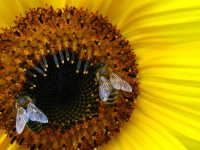 Recently in Britain 1,000 people showed up to enroll in a single course for novice bee-keepers. People throughout the world know that bees are in trouble after reading about Colony Collapse Disorder and want to do what they can to stop the honey bees’ decline. By 2006 most apiarists were reporting up to one-third of their bees gone or dead. Is it the various mites, pesticides, long distance traveling that wears down our friends? The largest wild blueberry company in Maine called Wyman’s owns 10,000 acres of blueberry terrain and they know that their 125 year old business is finished if a solution is not found soon. They have given a large grant to scientists to try and find out what needs to be done. Citizen science is also coming forward and helping biologists to understand the problem. Gretchen LeBuhn started the Great Sunflower Project- see www.sunflower.org- to try to have a better knowledge of what bees were up to across Canada and the U.S. She has over 60,000 volunteers who plant a sunflower in their yard, watch for all sorts of bees and then send in their data. It’s a wonderful way to encourage young people to become naturalists and know how important all kinds of bees are for pollination.
After 22 years of keeping bees I can understand why men and women want this ultimate nature hobby. What is so unique about bee-keeping is the egalitarian interaction with another species. The European honey bee, Apis mellifera, is an equal in its relationship with humans. If a bee-keeper does not treat his bees with due respect, or if their lodging is not to their satisfaction, they may just fly away. Good beekeepers are careful to leave enough honey in the hive so the bees survive the winter. Pragmatism and outright admiration for these insect’s social order creates the perfect partnership.
We have all heard of the bee dances that communicate information to the colony. Observing bees enter their colony is an inspiring experience. For example, watch how bees use ‘air-conditioning’ to cool down the hive by using their wings to fan the hot air out of the colony on a scorching summer day. In the fall a person can see the sad exit of perhaps ninety-five percent of the drones (male bees) being shoved out of the colony so the workers and the queen have enough honey for the winter. Catching a swarm is always an adventure. Swarming bees are looking for a new place to live, and swarms of thousands of bees announce themselves with a huge buzz as they cling to a branch. Bees are very safe to work with when they are swarming. If you see a swarm, call a bee-keeper and they will be happy to come by and catch it. Never spray the honey bees with an insecticide. Most people know how important bees are for our local apple industry and vegetable gardens. Fifteen billion dollars of added crops can be directly related to pollination by bees in North America.
There is no bylaw against having bees in the Town of Collingwood. Our bees, in the Beaver Valley, are twenty feet from our house and no one has ever been stung as a result of the hives’ proximity to the house. It would be a good idea to have a fence around the bees or a fenced- in backyard if you live in town. Young people can learn so much by sitting quietly next to the colony and observing all the wonderful activity taking place. Children love extracting honey too. Once the fields of goldenrod have finished in the fall, it is a true celebration tasting the honey and honouring the bees’ work by making sure they have a cozy hive for the winter.
Intransigence and inertia leaves young with few possibilities
“Self-restraint over consumption is a hugely subversive idea in an economic system which has as its core proposition that greater and greater happiness will follow every increase in our personal incomes and spending.” Chris Goodall, “How to Live a Low-Carbon Life
A new study from Princeton University’s Carbon Mitigation Initiative entitled, “Sharing Global CO2 Emissions Among1 Billion Emitters {out of 8.1 billion people in 2030}” points to humanity’s inability to find so far an equitable solution for the protection of our biosphere. This study tries to be a model in fairness with regards to capping world-wide emissions, and thus defuse the on-going conflict between the developed and developing world over who has to do what in order to get the greenhouse gas mitigation programs underway to avoid a catastrophic climate crisis. The study shows that the poorest 3 billion people can have a higher standard of living without any undue hardship incurred by people like ourselves. (Taking aim at world poverty on July 11 was UN World Population Day. We know the burgeoning population in this century means North Americans have to share more and ask for less.) Wealth and high GHG emissions go together: Europeans emit around 12.5 tonnes per person per year with North Americans doubling that amount, while the rest of the world averages less than 5 tonnes for each individual. Canadians would need to lower their emissions to a European level. Otherwise why should the rest of the world believe that any negotiations are credible between the rich and poor? Why would an Indian negotiator ever consider his Canadian counterpart’s proposals are made in good faith when we would not budge on our emissions? This just happened when the G8 industrial powers met the Group of 5 emerging powers last week in L’Aquila, Italy. Canada refused to accept more than “aspirational” goals in meeting temperature and greenhouse gas mitigation targets for 2050. UN Secretary General Ban Ki-moon was not at all pleased with the Group of 8’s action plans. According to World Wildlife Fund, Canada is the worst offender of the Group of 8.